
Exosomes Emerge as a New Frontier in Depression Research
A Molecular Psychiatry review proposes exosomes as key mediators linking neuroinflammation, synaptic plasticity, and the gut-brain axis in depression
Exosomes are gaining attention in depression research as candidates for both diagnosis and treatment. A recent review published in Molecular Psychiatry concludes that exosomes — small vesicles secreted by cells — are involved in signaling between the central nervous system and peripheral tissues, and may connect several biological pathways relevant to the pathophysiology of depression.
Exosomes are extracellular vesicles 30–150 nm in size that carry microRNAs, proteins, lipids, and metabolites. According to the review, their cargo can influence neuroinflammation, synaptic remodeling, HPA axis regulation, and gut-brain axis signaling. Depression involves a complex interplay of inflammatory responses, neurotransmitter dysregulation, stress reactivity, and gut microbiome changes — and exosomes may serve as mediators across these pathways.
On the diagnostic side, exosomes derived from blood, cerebrospinal fluid, and saliva are being explored as candidate biomarkers for depression. The review highlights exosomal microRNAs — including miR-16, miR-124, miR-132, and miR-146a — along with inflammatory markers such as IL-6 and TNF-α as leading candidates. Neuron-enriched exosomes in peripheral blood are of particular interest, as they may non-invasively reflect molecular changes in the brain.
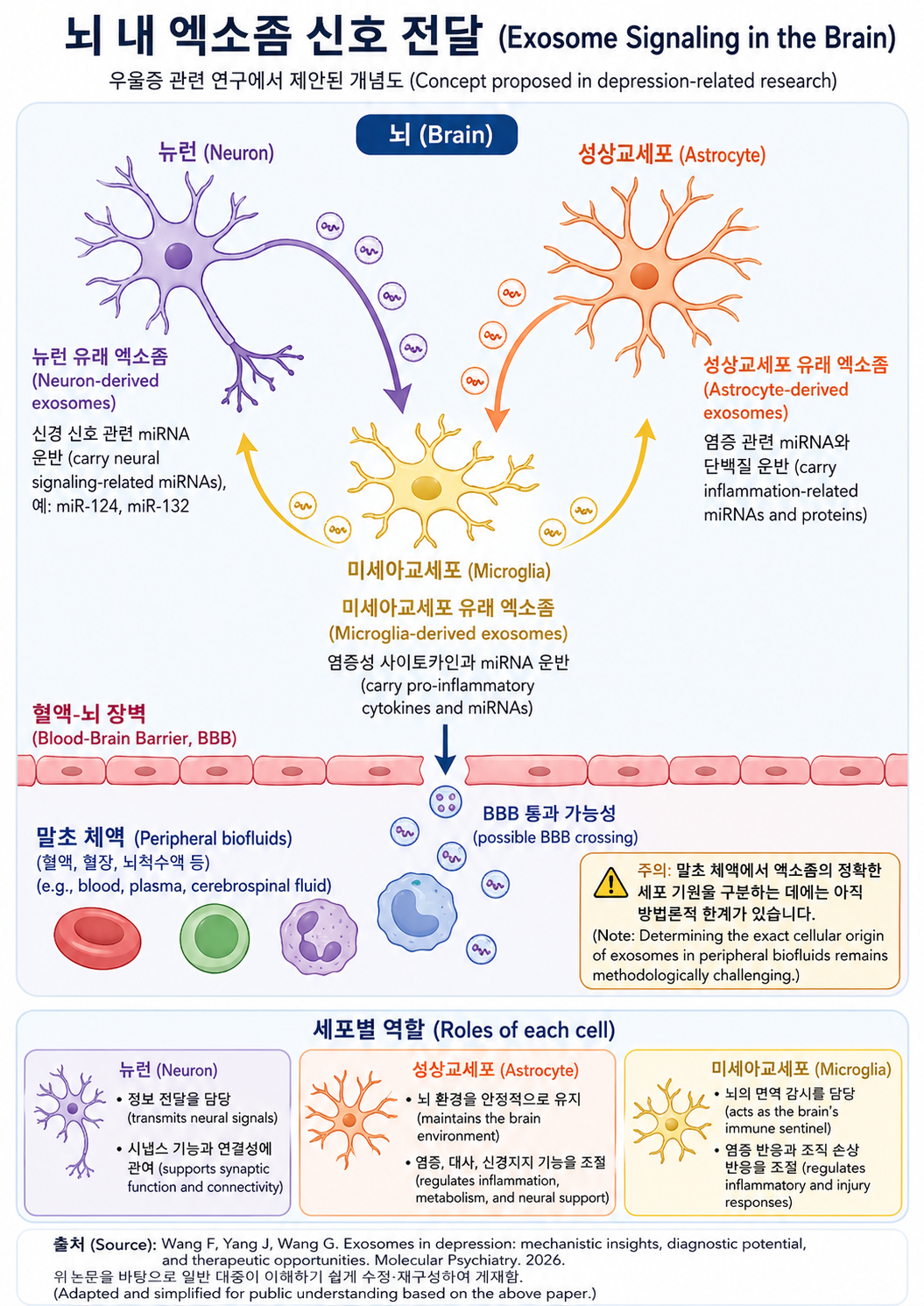 Figure: Exosome Signaling in the Brain. Adapted from Wang F et al., Molecular Psychiatry 2026.
The current evidence, however, remains preliminary. The review notes that most human studies are cross-sectional, with small sample sizes and inconsistent exosome isolation and analysis methods — limiting reproducibility. Identifying the precise cellular origin of exosomes detected in peripheral blood is an additional challenge. Exosome-based depression diagnostics should therefore be understood as a research-stage technology, not a clinically validated test.
On the therapeutic side, mesenchymal stem cell (MSC)-derived exosomes are the most actively studied. In animal models, MSC-derived exosomes have shown signals consistent with antidepressant effects — including modulation of microglial activation, attenuation of neuroinflammation, restoration of synaptic plasticity, and enhancement of neurotrophic signaling such as BDNF. Engineered exosomes have also been proposed as platforms for targeted delivery of anti-inflammatory or neuroplasticity-promoting cargo.
The review mentions iPSC-derived exosomes as having potential for standardization and scalable production. However, direct clinical evidence for treating depression remains scarce; most of the therapeutic case rests on preclinical studies. Clinical translation will require standardized manufacturing, dose definition, quality control, and long-term safety evaluation.
The authors suggest that exosome research could advance the understanding of depression not as a single disease but as a spectrum of biological subtypes — including inflammatory depression, treatment-resistant depression, depression with metabolic comorbidity, and post-traumatic brain injury depression. While inflammatory depression and major depressive disorder may share overlapping pathways (neuroinflammation, synaptic remodeling), their etiologies differ.
In conclusion, this review demonstrates that exosomes represent a promising platform connecting the pathophysiology, diagnosis, and treatment of depression. Significant validation remains before clinical translation. The authors call for longitudinal cohort studies, multicenter replication, standardized exosome isolation and analysis protocols, cell-of-origin tracing methods, and functional validation studies.
This review positions exosomes not as a confirmed cause of depression, but as an emerging research subject that connects neuroinflammation, synaptic changes, the gut-brain axis, and stress responses. The diagnostic and therapeutic potential is substantial, but the field remains firmly in the pre-clinical stage — well short of clinical application.
Wang F, Yang J, Wang G."Exosomes in depression: mechanistic insights, diagnostic potential, and therapeutic opportunities." Molecular Psychiatry, 2026 · DOI ↗
Looking beyond the research? For patient-oriented information on regenerative-medicine treatment options, continue to RegenValue.