
MSC-Derived Exosome Nanoformulations Emerge as Next-Generation Drug Delivery Platform for Targeted Cancer Therapy
Review in International Journal of Pharmaceutics maps biological rationale for delivering chemotherapy, RNA therapeutics, and immunomodulators to tumors / Current evidence is primarily preclinical — standardization, scale-up, and long-term safety remain key hurdles
Nanoformulations derived from mesenchymal stem cell (MSC) exosomes are drawing attention as a new drug delivery platform for targeted cancer therapy. A review article in press at International Journal of Pharmaceutics consolidates the evidence for MSC-derived exosome nanoformulations as a potential solution to key limitations of conventional oncology.
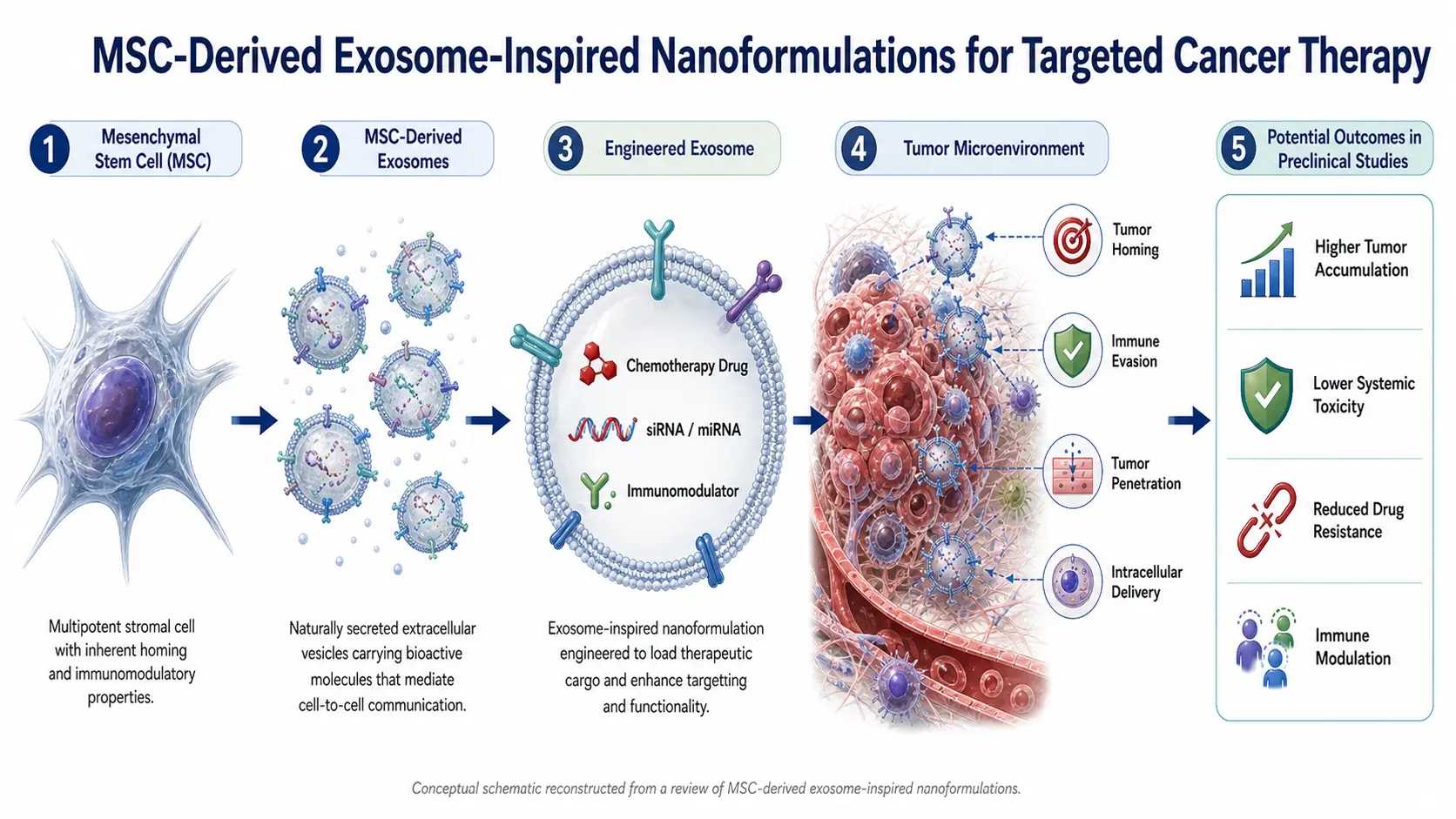 Five-step process: MSC → MSC-derived exosomes → engineered exosome loaded with chemotherapy drug / siRNA/miRNA / immunomodulator → tumor microenvironment → potential outcomes in preclinical studies. © Jadhav RS et al., International Journal of Pharmaceutics (2025)
Limitations of Conventional Cancer Therapy
Conventional cancer therapies suppress tumor cells but can affect healthy tissue as well, leading to adverse effects such as myelosuppression, gastrointestinal damage, alopecia, cardiotoxicity, and neurotoxicity. Beyond systemic toxicity, tumors present structural barriers — high cell density, elevated interstitial pressure, dense extracellular matrix, and irregular vasculature — that limit drug penetration into the tumor core. The review notes that these barriers contribute to poor therapeutic efficiency, drug resistance, and systemic toxicity.
What Are MSC-Derived Exosome Nanoformulations?
MSC-derived exosomes are presented as biologically derived nanocarriers that may address these challenges. Exosomes are small extracellular vesicles secreted by cells, capable of transferring proteins, lipids, and nucleic acids to target cells. MSC-derived exosomes in particular inherit certain properties of their parent cells, including tumor-homing capacity, low immunogenicity, biocompatibility, and intracellular delivery capability.
Mechanism: Four Key Processes
The review describes the action of MSC-derived exosome nanoformulations across several stages.
Tumor-directed migration: Surface receptors on exosomes — including CXCR4 and CCR2 — can follow chemokine signals such as CXCL12 and CCL2 secreted within the tumor microenvironment, guiding exosomes toward tumor sites. Adhesion molecules such as integrin and CD44 interact with the tumor extracellular matrix to promote exosome retention.
Immune evasion: Surface proteins including CD47, CD55, and CD59 on MSC-derived exosomes may reduce clearance by macrophages and the complement system, extending circulation time and increasing the likelihood that therapeutic cargo reaches the tumor site.
Tumor penetration: Despite the dense stroma characteristic of certain cancers such as pancreatic cancer, the nanoscale size of exosomes allows partial tissue penetration that conventional carriers may not achieve.
Intracellular cargo delivery: Exosomes can enter cancer cells via receptor-mediated endocytosis, membrane fusion, or macropinocytosis. They can partially evade lysosomal degradation and release cargo into the cytoplasm — making them applicable not only for chemotherapy but also for nucleic acid therapeutics such as siRNA and miRNA.
Therapeutic Applications
Chemotherapy Delivery
Studies loading paclitaxel, gemcitabine, doxorubicin, and cisplatin into exosomes reported enhanced intratumoral drug accumulation and reduced systemic toxicity. In pancreatic cancer models, exosome-based carriers showed penetration into dense tumor stroma, with reports of improved drug accumulation and survival benefit. In osteosarcoma models, doxorubicin-loaded MSC-derived exosomes demonstrated greater tumor suppression with reduced cardiotoxicity compared to free doxorubicin.
RNA-Based Therapeutics
siRNA and miRNA can silence cancer-related genes or restore tumor suppressor signaling, but are rapidly degraded in vivo and struggle to enter cells. The review describes MSC-derived exosomes as a protective delivery platform for nucleic acid therapeutics. Examples include delivery of survivin siRNA, LCP1 siRNA, miR-122, and miR-199a to suppress cancer cell proliferation and invasion, or restore chemosensitivity.
Immunomodulation and Combination Therapy
MSC-derived exosome nanoformulations may reprogram the tumor microenvironment — promoting M1 macrophage polarization from M2, enhancing CD8+ T cell and NK cell anti-tumor activity, and facilitating dendritic cell maturation. This extends beyond cargo delivery toward converting an immunosuppressive tumor environment into one capable of anti-tumor immune response.
A Critical Note: Dual Effects
The review emphasizes that MSC-derived exosomes do not uniformly exert anti-cancer effects. The MSC secretome and exosomes can exhibit both tumor-suppressive and tumor-promoting properties depending on context. Some miRNAs and growth factors may promote angiogenesis, cancer cell proliferation, invasion, or drug resistance. Conversely, tumor-suppressive miRNAs such as miR-16, miR-100, miR-122, and miR-199a can inhibit cancer cell growth and metastasis and enhance chemosensitivity. Cell source, cargo selection, surface engineering, and manufacturing process control are therefore critical parameters in therapeutic development.
Current Level of Evidence
This review primarily synthesizes in vitro and animal model data. Human studies are mentioned, but current evidence reflects early-phase evaluation of safety, tolerability, and pharmacokinetics rather than large-scale efficacy trials. MSC-derived exosome nanoformulations should be understood as a promising and actively researched platform in targeted drug delivery — not as an established clinical cancer treatment.
Hurdles for Clinical Translation
The review identifies several outstanding challenges. Exosome isolation, purification, and characterization methods remain incompletely standardized, with significant batch-to-batch variability and unresolved issues around manufacturing yield and cost. Stable loading of therapeutic cargo, long-term safety assessment, regulatory classification, and quality control criteria must be established before clinical translation can proceed.
Conclusion
This review positions MSC-derived exosome nanoformulations as a next-generation platform for precision oncology. This does not mean clinical efficacy has been established. Current evidence is predominantly preclinical, and validation through standardized manufacturing, reproducible quality control, long-term safety data, and human clinical trials remains necessary.
The appropriate framing is: “MSC-derived exosome nanoformulations are under active investigation in targeted drug delivery” or “preclinical studies have reported improvements in drug delivery efficiency and reductions in toxicity.”
Source
This summary is based on the review article “Mesenchymal Stem Cell-Derived Exosome-Inspired Nanoformulations: A New Frontier in Targeted Cancer Therapy” by Ranjit S. Jadhav et al., in press at International Journal of Pharmaceutics. The review covers mechanisms of MSC-derived exosome nanoformulations, applications in chemotherapy and RNA delivery, immunomodulatory potential, and challenges in manufacturing and standardization.
International Journal of Pharmaceutics is an international peer-reviewed journal in pharmaceutical sciences published by Elsevier, with an Impact Factor of 5.2 and CiteScore of 10.1.
MSC-derived exosome nanoformulations are being investigated as biomimetic drug delivery platforms combining tumor targeting, immune evasion, and intracellular cargo delivery. Preclinical studies report improved drug delivery efficiency and reduced toxicity, but standardization, scalable manufacturing, and long-term safety validation remain essential prerequisites for clinical translation.
Jadhav RS, et al.."Mesenchymal Stem Cell-Derived Exosome-Inspired Nanoformulations: A New Frontier in Targeted Cancer Therapy." International Journal of Pharmaceutics, 2025
Looking beyond the research? For patient-oriented information on regenerative-medicine treatment options, continue to RegenValue.